 Paul Bieganski
Top Threat to US Power Grid: Squirrels
 Packet Power Team : March 2017
Squirrels are the top animal threat to the US power grid. Learn how they cause outages and what utilities can do to reduce disruptions.


HEAR FROM OUR CUSTOMERS
Check out these real world examples of how Packet Power transformed our customers’ operations.

STAY UP-TO-DATE WITH OUR BLOG
Keep up with the latest innovations and trends in energy and environmental monitoring.

LOOKING FOR HELP?
Our technical support team is happy to assist.

Three-phase power is one of the most important electrical concepts behind dependable operations in data centers, industrial facilities, healthcare environments, telecommunications sites, and other power-intensive buildings. Yet it is often explained in a way that feels unnecessarily abstract.
The practical idea is straightforward: three-phase power delivers electrical energy through three synchronized alternating-current waveforms separated by 120 electrical degrees. Because the phases take turns reaching their peaks, the system can deliver power more smoothly and efficiently than a comparable single-phase arrangement. In balanced systems, the return current cancels out, so a neutral conductor may be unnecessary in a Delta configuration.
That “missing neutral” is not magic. It is the result of balanced electrical loads and phase relationships. Understanding it helps facilities teams make better decisions about electrical distribution, capacity planning, energy monitoring, power quality, and uptime protection.
For teams responsible for critical infrastructure, three-phase power is more than an electrical theory lesson. It is part of the operating foundation that supports servers, cooling equipment, switchgear, medical systems, manufacturing lines, automated warehouses, and the systems people depend on every day.
Three-phase power is an alternating-current, or AC, electrical system that uses three voltage waveforms. Each waveform is offset from the others by one-third of a cycle, or 120 degrees. The phases are commonly labeled A, B, and C, or L1, L2, and L3. In some diagrams, they may be labeled X, Y, and Z.
In a single-phase system, the voltage rises and falls on a single waveform. That is often suitable for smaller loads such as lighting, office outlets, and many household appliances. In a three-phase system, the three waveforms overlap. As one phase approaches a low point, another is rising or near its peak. The combined power delivery is much more consistent.
This smoother delivery makes three-phase power well-suited to equipment that draws substantial power or needs stable torque and performance, including:
Three-phase power can also reduce the amount of conductor material needed to deliver a given amount of power when compared with multiple independent single-phase circuits. For operators managing crowded electrical rooms, constrained pathways, or a complex construction schedule, fewer conductors can mean a cleaner and more manageable installation.
The main value is not simply that three-phase power is more powerful. It provides facilities with a practical way to distribute significant electrical loads efficiently while supporting more stable operation of critical equipment.
Electricity is invisible, so a plumbing analogy can make the behavior of three-phase power easier to picture.
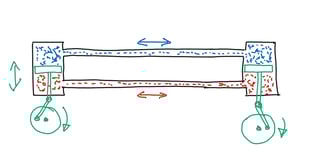
Imagine a closed-loop hydraulic system with two pipes. One pipe delivers water under pressure to a hydraulic engine, while the other returns water to the source. The water flow reverses direction on a repeating cycle. In electrical terms, this resembles a basic alternating-current circuit: one conductor delivers current toward the load, and the other provides the return path.
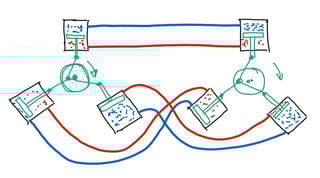
Now imagine that you need three times as much hydraulic work. You could build three separate two-pipe systems. Each one would have a delivery pipe and a return pipe, giving you six pipes in total.
But there is a more efficient approach. Run the three delivery flows at the same overall rate, while offsetting each one by exactly one-third of the cycle. At a given instant, one flow may be moving strongly forward, another may be changing direction, and the third may be moving strongly in the opposite direction.
When the three systems are balanced, the return flows offset one another. Instead of needing three separate return pipes, you may need only one shared return pipe to handle any imbalance. Under ideal balanced conditions, the shared return path carries no current.
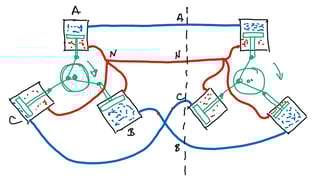
Single "N" pipe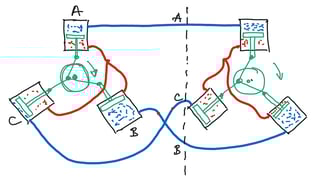
No "N" pipe at all
That shared return path is similar to the neutral conductor in a Wye electrical system. When the system is configured and loaded in a way that does not require that return path, the neutral is absent. This is the core idea behind the missing neutral in a Delta three-phase power configuration.
The analogy is not exact in every electrical detail, but it captures the important operational point: balanced three-phase power lets the phases support one another, reducing unnecessary return current and improving the efficiency of power delivery.
Every AC phase rises, reaches a positive peak, falls through zero, reaches a negative peak, and then returns to zero. In a three-phase power system, each phase follows the same repeating waveform, but the timing is staggered.
Because the phases are evenly spaced, the total power supplied to a balanced three-phase load remains far steadier than the power supplied to a single-phase load. This matters especially for motors. A three-phase motor receives a rotating magnetic field that helps it start and operate smoothly, often without the additional starting components associated with many single-phase motor designs.
For facility operators, the key takeaway is that three-phase power provides equipment with stable, continuous energy. When systems are properly designed, commissioned, and monitored, this supports more predictable operations and can make capacity decisions easier to manage.
Three-phase power does not remove the need for careful electrical design. Phase imbalance, harmonics, loose connections, overloaded circuits, voltage issues, and poor power factor can still create risk. The advantage is that a well-understood three-phase system gives teams strong options for distributing, measuring, and managing demanding loads.
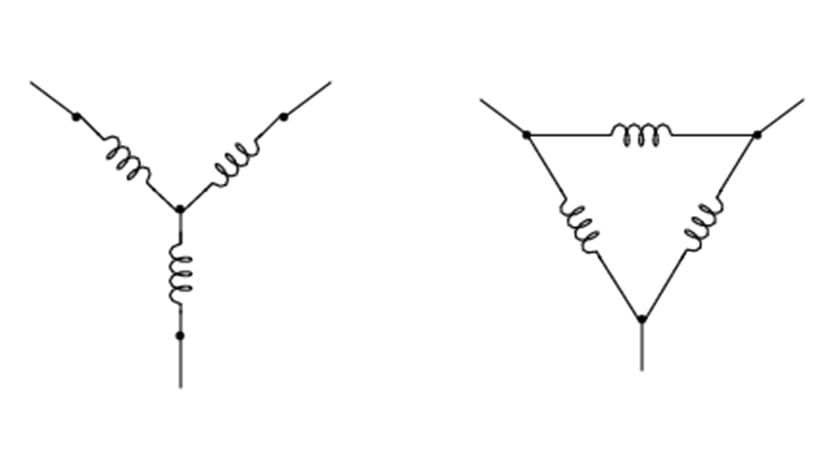
The two most common three-phase power configurations are Wye, also written as Y, and Delta, represented by the Greek letter delta, Δ. Both use three-phase conductors. Their main difference is how the windings or supply sources are connected and whether a neutral is available.
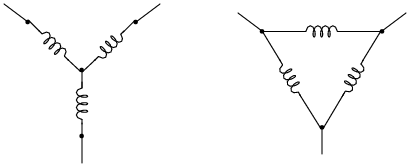
3-phase power systems: Y (Wye) and Delta
A Wye configuration connects one end of each phase to a common central point. That central point can serve as the neutral.
A typical Wye system includes:
A Wye system can supply both line-to-neutral and line-to-line loads. This flexibility is useful where a facility needs a mix of lower-voltage single-phase loads and higher-voltage three-phase loads.
For example, a common U.S. commercial configuration is 120/208V Wye. In that system:
This arrangement can power 120V lighting and receptacle circuits while also supplying 208V equipment such as servers, UPS inputs, HVAC equipment, and certain commercial appliances.
A Delta configuration connects the phases in a closed loop, forming a triangle. It normally has no neutral point because there is no central connection where the three phases meet.
A typical Delta system includes:
Because there is no neutral, standard Delta systems are generally used for line-to-line loads. This makes Delta a common choice for motors, industrial equipment, and other three-phase machinery designed for the available line voltage.
A Delta arrangement is often described as a 3-pole, 3-wire system, or 3P3W, excluding the grounding conductor. When a grounding conductor is included, some teams may describe the installed arrangement as 3-pole, 4-wire, or 3P4W. Terminology can vary by equipment type and application, so electrical drawings and local code requirements should always govern the final installation approach.
In a balanced Delta system, the load current circulates between the phase conductors. There is no line-to-neutral connection because there is no neutral point. The phase relationship allows the system to deliver three-phase power through three current-carrying conductors.
The neutral has not disappeared mysteriously. It is simply not part of the circuit topology. A Delta system is designed around phase-to-phase voltage and loads rather than phase-to-neutral loads.
|
Feature |
Wye (Y) |
Delta (Δ) |
|
Phase conductors |
Three |
Three |
|
Neutral conductor |
Usually available |
Usually not available |
|
Typical loads |
Single-phase and three-phase loads |
Primarily line-to-line and three-phase loads |
|
Common applications |
Offices, data centers, commercial facilities, mixed-use electrical distribution |
Industrial motors, manufacturing equipment, certain legacy or specialized systems |
|
Voltage measurements |
Line-to-neutral and line-to-line |
Line-to-line, with special cases in some systems |
|
Operational monitoring focus |
Phase loading, neutral current, line-to-line and line-to-neutral voltage |
Phase loading, line-to-line voltage, balance, power quality |
The best configuration depends on the facility’s electrical design, equipment requirements, existing infrastructure, transformer setup, and future capacity plans. The key is not deciding that one configuration is universally better. The key is having clear visibility into how the existing system is performing.
One of the most common sources of confusion in three-phase power is the relationship between phase voltage and line voltage.
In a balanced Wye system, line-to-line voltage is approximately 1.732 times the line-to-neutral voltage. The number 1.732 is the square root of 3.
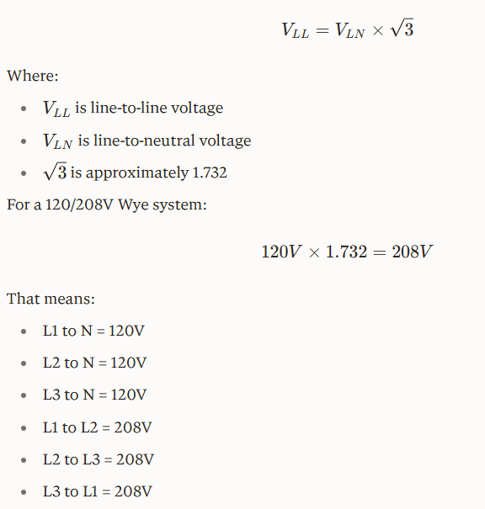
The 208V value is sometimes mistakenly treated as equivalent to 220V or 240V. It is not. Equipment voltage tolerances, input ratings, and manufacturer specifications matter. A device designed for 208V may be appropriate for a 208V supply, while another device may require 240V or another nominal voltage.
Other common three-phase voltage systems include 277/480V Wye and 240V Delta. The labels describe nominal voltages, not a universal set of interchangeable equipment ratings. Before connecting equipment, teams should verify the nameplate requirements, distribution design, transformer configuration, and applicable codes.
A balanced three-phase load draws approximately equal current on all three phases. When loads are balanced, the system operates more predictably and neutral current in a Wye system can be very low.
In an unbalanced system, one phase carries more load than the others. This can lead to uneven voltage behavior, excess neutral current in certain Wye systems, higher losses, reduced available capacity, overheating concerns, and more complicated troubleshooting.
Perfect balance is uncommon in operating facilities because loads change. Servers are added, motors cycle, tenants use equipment differently, and construction modifications introduce new branch circuits. The goal is not perfection. The goal is visibility, early detection, and informed corrective action.
Energy monitoring is essential because panel schedules and one-time commissioning measurements cannot show everything that happens during normal operation. Continuous monitoring can reveal whether one phase is trending toward overload, whether a circuit has unusual demand, or whether a facility has stranded capacity that could be used safely.
For overloaded operations teams, this replaces uncertainty with evidence. Instead of guessing whether a panel has room for a new load or spending hours with a handheld meter, teams can make decisions with current electrical data.
Three-phase power is used across many industries, but the operational risks differ in each. The common challenge is the same: teams need dependable visibility without adding unnecessary complexity, disruption, or wiring burden.
Data centers depend on three-phase power to support racks, PDUs, UPS systems, CRAC and CRAH units, chillers, pumps, and other infrastructure that protects uptime. A phase imbalance or overloaded branch circuit can affect capacity planning, reduce resiliency, and create avoidable risk during expansion.
Data center teams need circuit-level insight into current, voltage, power, energy, power factor, and load balance. They also need monitoring that can be installed with minimal disruption in dense and active environments. Wireless energy monitoring can reduce installation complexity while providing facilities and operations teams with a more reliable view of electrical usage.
Telecommunications facilities often support equipment that cannot simply be taken offline for a long electrical investigation. Network rooms, central offices, edge facilities, and tower-support infrastructure require teams to understand power draw, redundancy, and capacity before an issue threatens service continuity.
Three-phase monitoring helps telecom operators identify load concentration, track equipment additions, and verify that electrical distribution is operating as intended. That level of visibility supports confident maintenance planning and reduces the pressure of responding only after alarms or outages occur.
Financial services organizations rely on continuous computing, secure communications, trading systems, branch infrastructure, and back-office operations. A power issue can become a business continuity issue quickly.
Monitoring three-phase power at panels and branch circuits helps facilities teams identify capacity constraints before a new IT deployment or building modification causes problems. It also supports energy reporting, risk management, and better coordination between facilities, IT, and business stakeholders.
Government and defense facilities may operate with strict security, compliance, continuity, and documentation requirements. Electrical monitoring projects can be complicated by occupied spaces, limited access windows, aging infrastructure, and the need to avoid unnecessary dependencies on facility networks or invasive installation work.
Three-phase power monitoring provides useful operational evidence for critical loads, distribution equipment, and capacity. A wireless approach can simplify deployment in difficult environments, supporting teams that need reliable data without turning a monitoring project into a major construction event.
Commercial real estate owners, property managers, and construction teams face increasing pressure to understand tenant loads, building energy use, operating costs, and available capacity. In new construction, the problem is often keeping schedules on track. In existing buildings, it is often gaining insight without costly rewiring or extended downtime.
Three-phase energy monitoring helps teams validate electrical design assumptions, document load profiles, and identify circuits that are underused or approaching limits. For property teams, clear power data supports more confident tenant improvements and capital planning.
Industrial plants depend on three-phase motors, drives, pumps, compressors, conveyors, process systems, and control equipment. Electrical issues can affect production, maintenance labor, product quality, and delivery commitments.
By monitoring three-phase loads, industrial teams can spot phase imbalances, unusual demand patterns, and equipment consuming more power than expected. This does not replace a full maintenance program, but it gives maintenance and operations teams another signal for prioritizing attention before a small electrical issue becomes a costly interruption.
Hospitals, clinics, laboratories, and care facilities need reliable power for patient care, diagnostics, refrigeration, ventilation, imaging, IT, and emergency systems. Facilities teams must protect uptime while working around occupied spaces and sensitive operations.
Three-phase power monitoring supports capacity planning and helps teams understand how critical distribution systems are being used. Wireless installation can be particularly helpful where minimizing disruption matters. The result is a calmer, more controlled approach to electrical oversight, with less need to rely on assumptions or periodic manual checks.
Schools, universities, and research campuses may operate a wide mix of legacy buildings, laboratories, residence halls, athletic facilities, data rooms, and central plants. Their electrical loads vary significantly by season, occupancy, research activity, and campus events.
Monitoring three-phase power helps campus teams compare building demand, identify load imbalances, support energy initiatives, and plan upgrades with stronger evidence. It can also help teams explain electrical conditions to finance, sustainability, and leadership stakeholders in a clear and actionable way.
Energy service companies need accurate, scalable data to evaluate savings opportunities, establish baselines, verify performance, and communicate project outcomes. Manual data collection can be slow, expensive, and difficult to scale across multiple client sites.
Three-phase energy monitoring provides the detailed electrical measurements ESCOs need to identify demand patterns and evaluate major loads. A flexible monitoring platform can help teams collect useful data without making each deployment overly complex, which supports more efficient project delivery and stronger client confidence.
Pharmaceutical and biotechnology organizations often operate laboratories, clean environments, cold storage, process equipment, high-density computing, and tightly controlled HVAC systems. Power disruptions or poorly understood capacity can create risks beyond basic operating costs.
Three-phase monitoring helps facilities teams understand electrical demand across important systems and prepare for expansion, equipment changes, and compliance-driven operational needs. Reliable data gives teams a firmer foundation for decisions in facilities where details matter.
Distribution centers and warehouses rely on conveyor systems, sorting equipment, refrigeration, charging stations, automation, lighting, and HVAC. Peaks in demand can shift with shipment volume, operating hours, weather, and automation schedules.
Monitoring three-phase power can show how major systems behave during peak periods and help teams identify uneven loading or capacity constraints. That visibility supports practical decisions about adding automation, scheduling maintenance, and avoiding surprise electrical limitations during growth.
Agriculture operations may use three-phase power for irrigation pumps, grain handling, refrigeration, ventilation, processing, packing, and controlled-environment systems. Many sites must maintain dependable operations with lean teams and geographically distributed assets.
Electrical monitoring helps operators see whether pumps, motors, and refrigeration-related loads are operating within expected ranges. It can also support energy management and better planning, where travel time and on-site troubleshooting are significant operational burdens.
Stadiums, arenas, convention centers, and event venues experience dramatic shifts in electrical demand. Lighting, broadcast systems, kitchens, HVAC, scoreboards, security, concessions, and temporary production equipment can all affect the load profile during an event.
Three-phase monitoring helps facility teams prepare for high-demand periods, verify capacity for temporary equipment, and identify unexpected changes in power usage. When the venue is full and the schedule is tight, teams benefit from having reliable data before a problem becomes visible to guests, performers, broadcasters, or event organizers.
Retail organizations manage stores, distribution hubs, refrigeration, lighting, HVAC, point-of-sale systems, and increasingly, electric vehicle charging or other new electrical loads. Across a portfolio of locations, small inefficiencies and recurring electrical issues can add up to high costs.
Three-phase monitoring supports visibility into load behavior across stores and facilities. It helps teams identify locations that may need attention, support energy initiatives, and make more informed decisions about upgrades without treating every site as an unknown.
Original equipment manufacturers may integrate three-phase systems into machines, skids, modular equipment, and customer-facing solutions. Their customers expect dependable performance, clear documentation, and a product that is straightforward to deploy and support.
Integrated monitoring can give OEMs better visibility into equipment behavior, commissioning conditions, and field performance. It can also strengthen the value of their offering by helping end users understand power consumption and operating patterns without adding a complex separate monitoring project.
A useful three-phase power monitoring strategy should go beyond a single total-kilowatt reading. Total consumption matters, but it can hide the phase-level conditions that create operational risk.
Key measurements include:
Power factor deserves special attention. It describes how effectively a system converts apparent power into useful work. A lower power factor can increase the current required to deliver a given amount of real power. Depending on the utility tariff and facility design, a poor power factor can contribute to higher costs or reduce usable electrical capacity.
Monitoring also supports troubleshooting. If a three-phase motor, PDU, UPS, or HVAC component begins to behave differently, a change in current draw or phase balance can help teams investigate with more context. Monitoring does not diagnose every fault on its own, but it helps teams see where to look first.
Traditional monitoring installations can be difficult in active facilities. Teams may face full panels, short maintenance windows, restricted pathways, coordination with IT, uncertain drawings, or concerns about adding another complex system to support.
Packet Power is built for teams that want dependable electrical visibility without making installation harder than it needs to be. Its wireless monitoring approach can help reduce the wiring and network dependencies that slow down conventional monitoring projects.
That matters because facilities teams are already balancing competing priorities. They are supporting uptime, responding to requests, managing contractors, planning expansions, controlling energy costs, and maintaining equipment. A monitoring system should provide clarity, not create another project that requires constant attention.
Packet Power helps teams monitor three-phase power across branch circuits and multi-circuit applications in Wye and Delta configurations. By capturing phase-level measurements and total power and energy consumption, teams can move from periodic snapshots to a more dependable operational view.
The value is practical:
Choosing a monitoring platform should feel like a safe operational decision. The best solution makes complex electrical information easier to use, gives teams confidence in what they are seeing, and helps them act before pressure turns into firefighting.
Three-phase power is a foundational part of modern electrical distribution. Its phase relationships allow facilities to deliver high power levels efficiently, support demanding equipment, and, in the right configuration, operate without a neutral conductor.
For critical facilities teams, understanding the difference between Wye and Delta systems, line-to-line and line-to-neutral voltage, and balanced versus unbalanced loads is only the first step. The next step is maintaining ongoing visibility into what the electrical system is doing.
Packet Power helps organizations monitor three-phase power in data centers, telecom sites, industrial operations, healthcare facilities, campuses, warehouses, and other demanding environments. Our wireless monitoring solutions are designed to make electrical insight simpler to deploy, easier to scale, and more dependable to use.
When you can see the electrical conditions behind your operation, you can plan with more confidence, reduce unnecessary stress, and spend less time reacting to surprises. That is how power monitoring becomes more than measurement. It becomes control.
Talk with Packet Power about three-phase power monitoring and energy visibility.
Three-phase power is generally better suited to large, power-intensive, and motor-driven loads because it delivers energy more consistently and can distribute substantial power efficiently. Single-phase power remains appropriate for many smaller loads. The right choice depends on the equipment, the building's electrical design, and the operational requirements.
A neutral is not always needed because balanced three-phase loads can return current through the other phase conductors. In a Delta configuration, the phases are connected in a closed loop, and there is typically no neutral point. In a Wye configuration, a neutral is available at the common center point and can support line-to-neutral loads.
208V commonly refers to the line-to-line voltage in a 120/208V Wye system. A 240V Delta system has 240V between phases. They are different nominal voltages, and equipment must be rated for the supply it will receive.
Yes. Unbalance occurs when loads are not distributed evenly across the three phases. Some variation is normal, but a significant imbalance can reduce capacity and complicate operations. Continuous monitoring helps teams find and address it.
A standard Delta system typically uses three current-carrying phase conductors and a grounding conductor for safety. A Wye system commonly uses three-phase conductors, a neutral, and a grounding conductor for safety. The exact configuration depends on the electrical system and applicable codes.
Some meters can measure basic voltage or current, but comprehensive three-phase monitoring requires equipment designed to capture all relevant phase-level parameters, total power, energy, and trends. The appropriate meter depends on the system configuration, voltage and current ranges, and monitoring objectives.
 Packet Power Team : March 2017
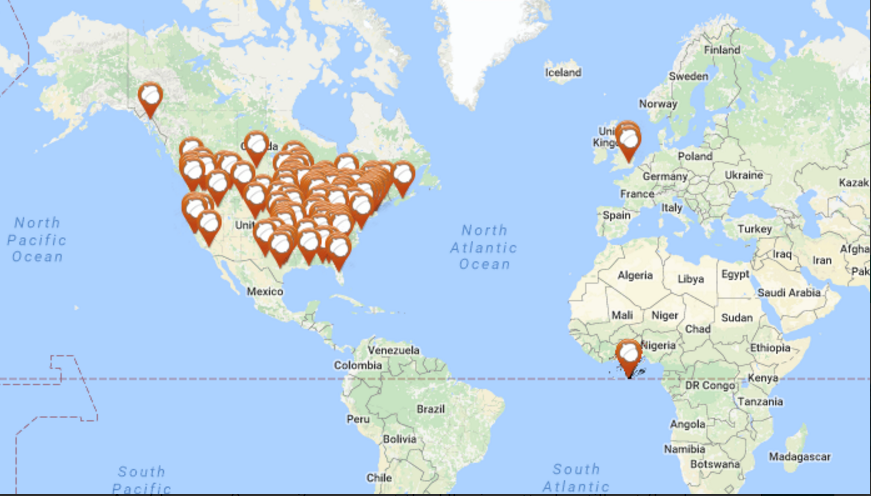
Squirrels are the top animal threat to the US power grid. Learn how they cause outages and what utilities can do to reduce disruptions.
 Packet Power Team : November 2021
Confused by data center acronyms? Get clear, concise definitions of key terms in operations management with Packet Power’s expert guide!
 Packet Power Team : October 2021
Power and environmental monitoring help reduce downtime by keeping you abreast of operating conditions within your data center or other facilities.