Electricity is easy to take for granted until a circuit reaches capacity, an equipment room overheats, a utility bill spikes, or a critical system goes offline. For facilities teams, power is not simply an operating expense. It is a capacity constraint, an uptime risk, and a major part of the organization’s reputation.
Understanding volts, amps, watts, watt-hours, and electricity costs gives operators the foundation to make confident decisions. Whether you manage a data center, hospital, warehouse, telecom network, manufacturing line, retail portfolio, or government facility, the basic math behind electrical power helps answer important questions:
- Do we have enough capacity for new equipment?
- Which assets consume the most energy?
- Where are we paying for avoidable waste?
- Are electrical loads balanced and operating safely?
- How can we find problems before they create downtime?
- Which monitoring investments will deliver measurable value?
Packet Power helps critical facilities teams turn complicated power and environmental data into practical insight. Wireless monitoring reduces the burden of difficult retrofits, dependence on IT resources, and manual data collection, so teams can spend less time chasing issues and more time maintaining control.
Why Electrical Power Basics Matter
Most facilities rely on electricity for lighting, heating, cooling, IT equipment, motors, refrigeration, communications, automation, and security. Yet many teams only see power usage at the utility meter or on a monthly bill. That high-level view does not reveal how energy is being consumed across buildings, circuits, racks, machines, tenants, or operating zones.
This creates a familiar challenge: when costs rise or a system fails, operators must investigate with incomplete information.
A utility bill may show that a facility used more electricity this month than last month, but it cannot explain:
- Which equipment drove the increase
- Whether the increase occurred during peak operating hours
- Whether cooling systems are compensating for excess heat
- Whether a new load is approaching circuit capacity
- Whether a process, tenant, or department should be assigned the cost
- Whether an equipment issue is causing energy waste
- Power monitoring gives teams the visibility needed to move from assumptions to evidence.
The U.S. Energy Information Administration reported average May 2026 electricity prices of 13.54 cents per kWh for commercial customers and 8.71 cents per kWh for industrial customers, though actual rates vary widely by state, tariff, usage profile, and demand charges. For facilities with substantial or always-on electrical loads, small efficiency improvements can translate into meaningful annual savings.
Just as important, visibility can protect uptime. An overloaded circuit, a rack running hotter than expected, or a refrigeration system consuming abnormal power may be an early warning sign. Catching those issues early helps teams protect equipment, service levels, and professional credibility.
Electricity Explained Simply
Electricity is the movement of electric charge through a conductor, usually copper wiring. A complete electrical system needs a path for current to flow from the power source, through the equipment that uses the power, and back through the circuit.
The most useful way to understand electricity is through five related concepts:
|
Electrical term
|
What it measures
|
Simple comparison
|
Why facilities teams care
|
|
Volts
|
Electrical pressure
|
Water pressure in a pipe
|
Determines how much electrical potential is available
|
|
Amps
|
Electrical current or flow
|
Water flow through the pipe
|
Helps determine conductor size and circuit loading
|
|
Watts
|
Power used at a specific moment
|
Pressure multiplied by flow
|
Shows instantaneous equipment demand
|
|
Watt-hours
|
Energy consumed over time
|
Total water delivered over time
|
Used to calculate energy usage and cost
|
|
Kilowatt-hours
|
1,000 watt-hours
|
Utility billing unit
|
Appears on most electricity bills
|
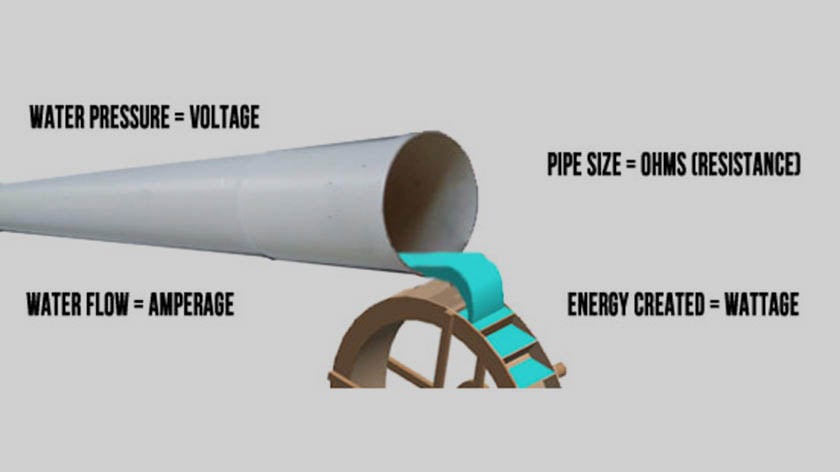
The water-pipe analogy is useful because voltage alone does not describe total power. A narrow pipe may have high pressure but deliver very little water. A larger pipe may carry a high flow rate, but without enough pressure, it cannot produce much useful work.
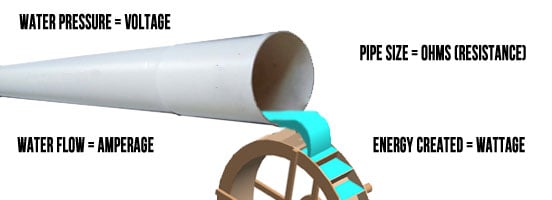
Water pipe analogy for understanding electricity
Electrical systems work the same way. You need to understand both voltage and current to determine power.
What Is Voltage?
Voltage, measured in volts and abbreviated as V, is the electrical potential difference. It is often described as electrical pressure because it represents the force that pushes electric charge through a circuit.
Higher voltage does not automatically mean higher energy consumption. Voltage tells you the available potential, but it does not indicate how much current is flowing or how much work the equipment is performing.
For example, a 480V electrical feed can deliver significant power, but the actual power depends on the current drawn by the connected load.
Common voltage levels in North American facilities include:
- 120V for standard outlets, office equipment, and light-duty loads
- 208V for many commercial, IT, and data center applications
- 240V for larger equipment and certain single-phase loads
- 277V for commercial lighting applications
- 480V for many industrial and commercial distribution systems
- Higher voltages for utility distribution and large-scale electrical infrastructure
Data centers often receive utility power at higher voltages, such as 480V, before stepping it down through transformers and distribution equipment for use by servers, networking gear, cooling systems, and other facility loads. Packet Power identifies power and environmental monitoring as essential for tracking equipment efficiency, cooling performance, uptime risks, SLA compliance, and operating-cost allocation in these environments.
Voltage also has a practical impact on electrical design. Higher-voltage systems can deliver the same amount of power with lower current, which can reduce conductor size and electrical losses in certain applications. However, electrical design, safety, and code compliance should always be handled by qualified professionals.
What Is Current in Amps?
Current is measured in amps (A). It represents the flow of electrical charge through a conductor.
If voltage is pressure, current is the volume of electricity moving through the wire.
Current matters because electrical cables, breakers, panels, PDUs, and other components have limits. When equipment draws more current than a circuit is designed to handle, the result can be overheating, nuisance trips, equipment damage, or an elevated risk of fire.
For example:
- A 20A branch circuit has a limited current capacity.
- A rack PDU may support a specific current rating, such as 20A, 30A, or 60A.
- An industrial motor may draw high current during startup.
- A poorly balanced three-phase electrical system can create uneven loading and reduce available capacity.
Facility teams often track amps because it is a fast way to understand circuit loading. But amps alone do not tell the complete story. Ten amps at 120V does not deliver the same power as 10 amps at 240V.
That is why watts are usually a more useful measure when comparing actual equipment demand.
What Are Watts?
Watts, abbreviated as W, measure electrical power. Power is the rate at which electrical energy is being used at a particular moment.
For a basic single-phase calculation:
Watts = Volts × Amps
If a device draws 10 amps at 240 volts:
10A × 240V = 2,400W
That device is using 2,400 watts (2.4 kilowatts) of power at that load.
A kilowatt, abbreviated as kW, equals 1,000 watts.
1kW = 1,000W
Watts are valuable because they allow teams to compare electrical demand across different voltage levels. For example:
|
Equipment load
|
Voltage
|
Current
|
Power
|
|
Office device
|
120V
|
5A
|
600W
|
|
IT equipment
|
208V
|
5A
|
1,040W
|
|
High-load system
|
480V
|
5A
|
2,400W
|
The same 5A current draw produces very different power levels depending on voltage. This is why power capacity planning requires more than a quick review of amperage.
In alternating-current systems, the calculation can become more complex because of power factor, phase configuration, and load characteristics. For many facility applications, a more complete single-phase formula is:
Real Power (W) = Volts × Amps × Power Factor
For three-phase systems:
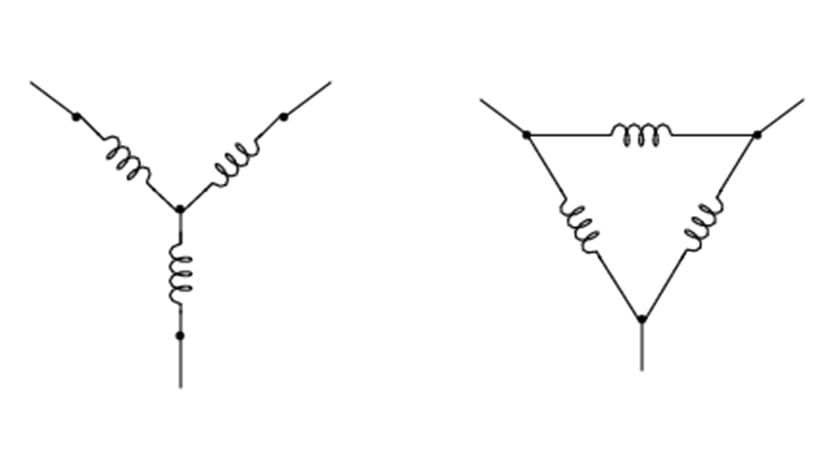
Real Power (W) = √3 × Voltage × Amps × Power Factor
Power factor is especially relevant for facilities running motors, variable-frequency drives, UPS systems, lighting, and other inductive or nonlinear loads. It helps distinguish between apparent power and the actual power performing useful work.
What Are Watt-Hours and Kilowatt-Hours?
Watts measure power at a moment in time. Watt-hours measure energy consumed over a period of time.
A watt-hour, abbreviated as Wh, is the energy used when one watt of power runs for one hour.
For example, a 100W light operating for 10 hours consumes:
100W × 10 hours = 1,000Wh
Since 1,000Wh equals 1 kilowatt-hour:
1,000 Wh = 1kWh
The light uses 1 kWh of energy.
Utilities typically bill electricity in kilowatt-hours. If you want to understand the energy cost of a device, a rack, a machine, or an entire facility, kWh is the metric that matters.
Use this formula:
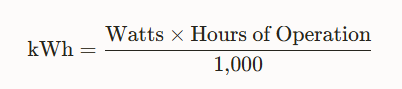
For example, a 500W server running continuously for one year consumes:
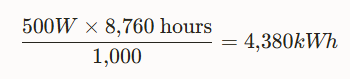
At a commercial electricity price of 13.54 cents per kWh, that server’s annual energy cost would be approximately:
4,380kWh × $0.1354 = $593.05
That calculation covers the server’s direct electricity use only. It does not include cooling, UPS losses, power distribution losses, or other facility overhead. In a data center, the energy required to support IT loads can substantially increase total operating costs.
How to Calculate Electricity Cost
To estimate electricity cost, use:
Electricity Cost = kWh Used × Electricity Rate
Or, starting from watts:

Here is a simple example.
A 2,000W piece of equipment runs 12 hours each day for 30 days:
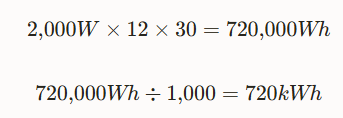
At $0.1354 per kWh:
720kWh × $0.1354 = $97.49
The estimated monthly electricity cost is $97.49.
Actual utility bills can be more complicated. In addition to energy charges, organizations may pay for:
- Demand charges based on peak kW usage
- Time-of-use pricing
- Capacity or transmission charges
- Power factor penalties or adjustments
- Taxes, riders, and local utility fees
- Seasonal rates
- Contracted electricity supply rates
This is why facility-wide monitoring is valuable. A monthly invoice tells you the total. Granular monitoring helps you identify the equipment, locations, and operating behaviors behind the total.
Power Monitoring Challenges by Industry
The need to understand power is shared across industries, but the operational risks are different. Packet Power serves a broad range of facilities, including data centers, telecommunications, financial services, government, healthcare, manufacturing, logistics, retail, agriculture, universities, stadiums, and pharmaceutical organizations.
1. Data Centers
Data center teams must maintain capacity, availability, efficiency, and customer confidence simultaneously. A lack of power visibility can lead to overloaded circuits, stranded capacity, hot spots, unplanned outages, and inaccurate tenant billing.
Monitoring voltage, current, power, energy, temperature, and humidity at the rack, PDU, branch circuit, and facility level helps teams:
- Identify underused and overloaded capacity
- Improve rack-level capacity planning
- Allocate energy costs by customer or department
- Detect cooling and airflow issues
- Support SLA reporting
- Reduce the risk of preventable downtime
Packet Power’s wireless monitoring approach helps data center operators expand visibility without the disruption and expense of extensive new cabling.
2. Telecom
Telecommunications networks depend on equipment that must operate continuously. Remote sites, central offices, shelters, and network infrastructure need dependable power visibility, especially where site visits are expensive or difficult.
Power monitoring helps telecom teams detect abnormal loads, battery system issues, environmental risks, and capacity limitations before they disrupt service. Wireless monitoring can reduce installation complexity in facilities where adding wired infrastructure creates scheduling, access, or operational challenges.
3. Financial Services
Financial institutions rely on secure, resilient infrastructure for trading, transactions, customer operations, branch networks, and data processing. An outage can create direct financial loss, regulatory risk, and damage to customer trust.
Power monitoring supports financial services organizations by helping facilities and IT teams understand equipment loads, identify risk conditions, improve energy accountability, and document performance. Packet Power notes that it has worked with global financial institutions facing security requirements that can complicate wireless monitoring deployments.
4. Government and Defense
Government and defense facilities often manage aging infrastructure, security requirements, energy-reduction targets, and critical operational demands. Teams need a practical way to gain visibility without causing unnecessary disruption or requiring extensive new wiring.
Monitoring electrical and environmental conditions helps facility managers prioritize maintenance, support energy-management initiatives, improve resilience, and document operational performance. The goal is not simply more data. It is dependable information that helps teams make decisions with greater confidence.
5. Real Estate and Construction
Commercial real estate owners, property managers, and construction teams need reliable energy data for tenant billing, building performance, capital planning, and project commissioning.
Wireless power monitoring can be particularly useful when retrofit work is disruptive, expensive, or difficult to coordinate with tenants. Construction teams can also use temporary or permanent monitoring to validate system performance, track construction power, and identify loads that may affect occupancy readiness.
6. Industrial and Manufacturing
Manufacturing and industrial operations depend on electrical reliability for motors, conveyors, pumps, compressors, process equipment, automation, and production lines. An electrical problem can stop production, delay shipments, and increase maintenance costs.
Monitoring helps teams identify:
- Unexpected changes in machine energy use
- Excessive idle-time consumption
- Abnormal motor or process loads
- Peak-demand contributors
- Equipment that may need maintenance
- Opportunities to improve energy intensity per unit produced
The outcome is greater operational control. Instead of reacting after a production issue becomes expensive, teams can use power data to spot changes earlier.
7. Healthcare
Hospitals, clinics, laboratories, and medical campuses must protect patient care, sensitive equipment, and essential services. Power reliability is central to that responsibility.
Monitoring can help healthcare teams understand critical-load performance, verify electrical capacity, monitor environmental conditions in equipment rooms, and support maintenance decisions. For facilities teams already balancing compliance, aging infrastructure, and urgent service demands, easy-to-deploy monitoring can reduce the burden of gathering reliable information.
8. Education
Universities, school districts, and campuses often manage a mix of old and new buildings, fluctuating occupancy, laboratories, athletic facilities, dormitories, and IT infrastructure. Without detailed energy data, it can be difficult to identify which buildings or systems are driving costs.
Power monitoring supports energy-management goals, capital planning, sustainability reporting, and operational improvements. It can also help campuses distinguish between normal seasonal variation and equipment behavior that deserves attention.
9. Energy Service Companies
Energy service companies need defensible measurements to establish baselines, validate savings, identify opportunities, and communicate results to clients. High-quality data helps turn energy recommendations into measurable business cases.
Wireless monitoring can help ESCOs capture detailed load data without imposing lengthy installation timelines. That can make audits, pilot projects, and performance-verification efforts faster and less disruptive.
10. Pharma and Biotech Organizations
Pharmaceutical and biotech facilities may operate laboratories, clean rooms, refrigeration, cold storage, manufacturing equipment, and data-intensive research environments. Electrical and environmental changes can affect product integrity, research continuity, and regulatory obligations.
Monitoring helps teams understand how critical systems are performing and identify abnormal energy use that could signal equipment stress. It also supports a more structured approach to protecting sensitive operations.
11. Logistics and Warehousing
Warehouses and logistics operations depend on lighting, HVAC, refrigeration, charging stations, conveyors, automation, and material-handling systems. Energy costs can rise quickly as operations scale, especially in facilities with high-throughput schedules or temperature-controlled storage.
Monitoring can help operators isolate high-consumption systems, manage peak loads, improve equipment scheduling, and identify inefficiencies that would otherwise go unnoticed in a facility-wide utility bill.
12. Agriculture
Agricultural operations may rely on irrigation pumps, ventilation, lighting, climate controls, refrigeration, processing equipment, and grow systems. A single electrical issue can affect productivity, product quality, and operating costs.
Power monitoring enables teams to see when equipment is consuming more energy than expected and respond before an issue leads to lost output or costly downtime.
13. Stadiums and Event Centers
Stadiums, arenas, convention centers, and event venues have highly variable loads. A facility may operate at low demand most days and then experience major power requirements during games, concerts, conventions, and broadcasts.
Monitoring helps facilities teams understand event-driven load profiles, identify peak-demand patterns, allocate event costs, manage temporary infrastructure, and maintain dependable conditions for guests, performers, vendors, and broadcast partners.
14. Retail
Retail organizations often manage large, distributed portfolios of stores, warehouses, refrigeration systems, lighting, HVAC equipment, and point-of-sale technology. Small energy inefficiencies multiplied across dozens or hundreds of locations can become a substantial cost.
Power monitoring enables a more consistent approach to benchmarking stores, identifying outliers, and prioritizing facility improvements. It helps regional teams spend less time guessing which location needs attention first.
15. Original Equipment Manufacturers
OEMs can use energy and environmental monitoring to add diagnostic value to equipment, validate performance, support service programs, and improve customer outcomes. Understanding how equipment behaves in the field can help manufacturers identify operating patterns, maintenance needs, and opportunities for product improvement.
For OEM customers, embedded or integrated monitoring can help transform equipment from a black box into a more transparent and manageable asset.
From Power Data to Confident Decisions
Knowing the difference between volts, amps, watts, and watt-hours is the first step. The greater value comes from applying that knowledge consistently across the facility.
A facilities team should be able to answer practical questions such as:
- Which circuits are closest to capacity?
- Which racks, machines, or zones consume the most power?
- When does peak demand occur?
- Is the equipment load behaving differently than it did last week or last month?
- Are cooling systems working harder because of IT or production heat?
- Can we support a planned expansion without creating avoidable risk?
- Which locations deserve attention first?
These questions are difficult to answer with manual readings, scattered spreadsheets, or a monthly electricity bill. Teams need accessible, timely, and trustworthy data.
Packet Power positions wireless monitoring as a way to simplify visibility into power and environmental conditions across complex facilities. Its solutions are designed to help operators install monitoring systems with less wiring, avoid unnecessary IT dependencies, and integrate data into broader facility management workflows.
That matters for teams that are already overloaded. The objective is not to add another dashboard for someone to manage. It is to reduce blind spots, shorten investigations, and help professionals make smart decisions before a small issue becomes a major operational problem.
Take Control of Energy Use
Electricity may be complex, but managing it does not have to be overwhelming.
Volts measure electrical pressure. Amps measure electrical current. Watts measure power demand at a moment in time. Watt-hours and kilowatt-hours measure energy use over time. Together, these measurements help facilities teams understand capacity, cost, efficiency, and risk.
For critical facilities, better visibility is more than an energy-management initiative. It is a way to protect uptime, strengthen planning, reduce operational stress, and maintain confidence when decisions matter most.
Packet Power helps teams monitor power and environmental conditions across critical facilities with dependable wireless technology built for practical deployment. From data centers and telecom sites to hospitals, industrial operations, campuses, warehouses, and retail portfolios, the right monitoring strategy can help turn complex electrical systems into manageable, actionable information.
Talk with Packet Power to explore how wireless power and environmental monitoring can help your team reduce uncertainty, protect operations, and stay ahead of energy and capacity challenges.
FAQs
What is the difference between volts, amps, watts, and watt-hours?
Volts measure electrical pressure, while amps measure the flow of electrical current. Watts show how much power equipment uses at a given moment, and watt-hours measure the amount of energy equipment consumes over time.
How do you calculate electricity cost from watts?
Multiply the device’s wattage by the number of hours it operates, then divide by 1,000 to find kilowatt-hours. Multiply the kWh total by your facility’s electricity rate to estimate the energy cost, keeping in mind that demand charges and other utility fees may also apply.
Why is power monitoring important for critical facilities?
Power monitoring helps facilities teams identify overloaded circuits, unexpected energy consumption, capacity constraints, and equipment issues before they cause downtime. It also provides data to support energy cost allocation, maintenance planning, and more confident infrastructure decisions.
What is power factor, and why does it matter?
Power factor shows how efficiently an electrical system converts incoming power into useful work. A lower power factor can increase electrical losses and may affect capacity planning, particularly in facilities that use motors, UPS systems, lighting, and variable-frequency drives.
Which industries benefit from wireless power monitoring?
Wireless power monitoring can support any organization that needs better visibility into energy use, electrical capacity, and the condition of critical equipment. Common applications include data centers, telecom sites, healthcare facilities, industrial plants, warehouses, campuses, retail portfolios, government buildings, and pharmaceutical environments.





 Paul Bieganski
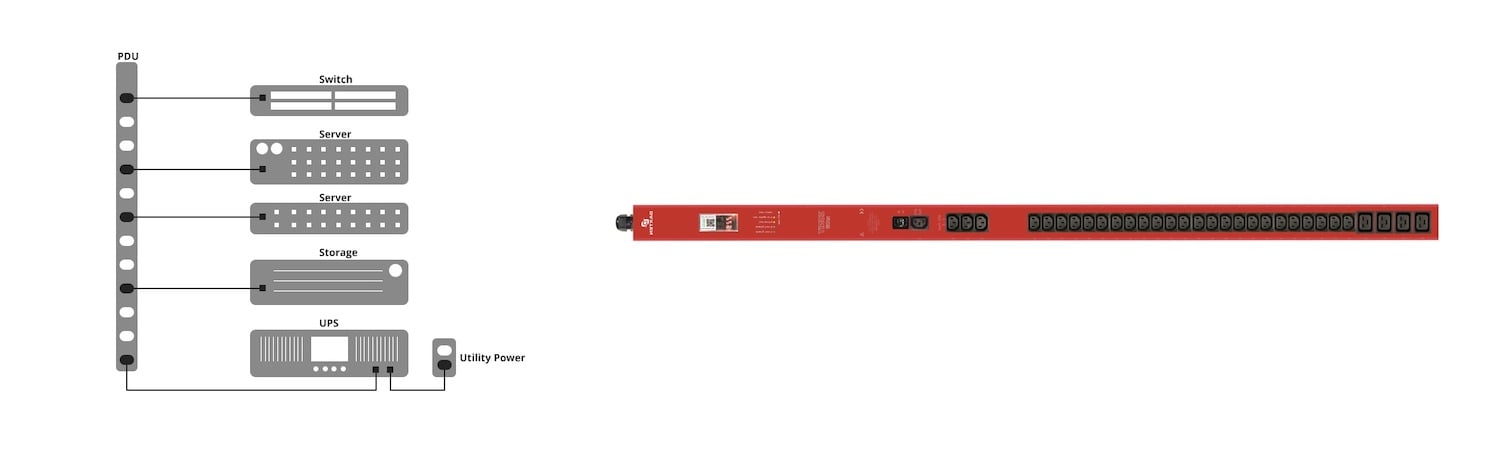
 Packet Power Team : September 2021