 Packet Power Team
1 min read
One Path to "Monitoring Nirvana"
 Packet Power Team : July 2017
We ran across a good article in the Data Center Journal written by Leon Adato entitled "Monitoring Nirvana" describing data center monitoring and who...


HEAR FROM OUR CUSTOMERS
Check out these real world examples of how Packet Power transformed our customers’ operations.

STAY UP-TO-DATE WITH OUR BLOG
Keep up with the latest innovations and trends in energy and environmental monitoring.

LOOKING FOR HELP?
Our technical support team is happy to assist.


Before you wait years for new utility power, ask a different question: Are you already using all of the power you have?
Data centers are spending enormous time and capital looking for new power. But in some operating facilities, the constraint may be more complicated than the total amount of power available. There may also be limited visibility into where capacity exists, whether it is available at the required distribution point, and how much can be deployed without compromising redundancy, cooling or uptime.
Without granular monitoring, it's difficult to know where capacity exists, what's truly available, and what's being held back by uncertainty. In the right facility, one of the fastest ways to deploy additional compute may not be new infrastructure. It may be understanding and more effectively using the infrastructure already installed.
A 40 MW data center doesn't automatically have 40 MW available for new workloads.
In reality, usable capacity can be limited by:
This distinction between installed capacity and usable capacity is where many facilities leave opportunity on the table. Until operators can measure these conditions throughout the electrical hierarchy, available capacity remains an estimate rather than an engineering-validated operating resource.
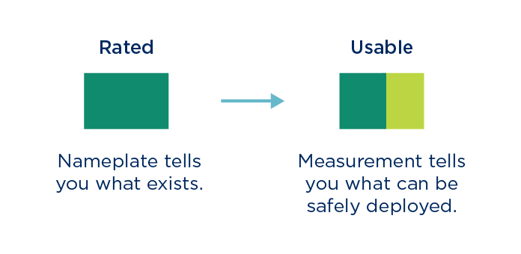
Operators don't intentionally strand capacity. Capacity can become stranded because uncertainty is expensive. Without detailed operating data, engineering teams appropriately maintain safety margins to protect uptime. Some of those margins are required. Others may be based partly on estimates, incomplete measurement or operating assumptions that have not been continuously validated.
Consider an illustrative 40 MW facility.* If granular power visibility, balancing and site-specific engineering supported an increase from 50% to 60% average facility utilization, the facility could accommodate 4.0 MW of additional total facility load.
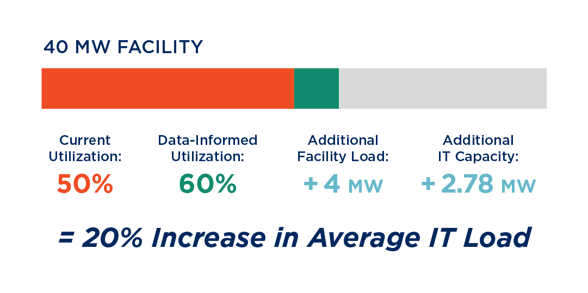 At a representative PUE of 1.44, that translates to approximately:
*Important qualification: This is an illustrative opportunity scenario—not a forecast, savings guarantee or universal operating profile. It does not establish that every 40 MW facility can safely increase average utilization to 60%. Actual deployable capacity depends on measured peaks, redundancy, failover requirements, breaker and equipment ratings, cooling performance, maintenance conditions, workload reservations and local distribution constraints.
Better visibility doesn't create capacity. It reduces uncertainty about the capacity that's already there.
Granular power monitoring helps operators determine:
The objective is not simply to measure energy consumption. It is to produce the operating evidence required to determine what capacity is genuinely usable.
Once usable capacity is identified, and approved for deployment, its value extends well beyond electrical engineering. Every month that additional compute can be deployed sooner has operational and financial implications that vary by business model.
The value of earlier capacity has three primary components:
Operating Value: What revenue, contribution or cost savings can the workload produce?
Time Value: How much economic output is delayed while the workload waits for power?
Capital Value: What infrastructure investment can be avoided or deferred?
The correct economic lens depends on the operator and the workload.
| Economic Lens | Representative Value | What is Measured |
| Enterprise or Hyperscale Workload Value | Customer-Specific | Revenue, Contribution Margin, Savings, or Strategic Acceleration |
| Wholesale Capacity Reference | $6.5 Million Per Year | Gross Rental Value at $196.25 per kW-month |
| Equivalent New-Build Capacity | $31.4 Million | Construction-Cost Equivalent at $11.3 Million per MW |
| AI Compute-Service Proxy | $69.3 Million Per Year | Gross Service-Value Proxy at 70% Utilization |
*These are alternative ways of valuing the same illustrative capacity. They should not be added together, and none should be interpreted as profit, cash flow, guaranteed customer savings or enterprise value.
When paired with site-specific engineering review and approval, granular operating evidence may allow new servers, AI infrastructure or other workloads to be deployed sooner—potentially before new utility power or major infrastructure upgrades become available.
Not every capacity challenge requires building more infrastructure. By making better use of the power already installed, organizations may be able to defer costly electrical upgrades, facility expansions, or new construction until they're truly needed.
The benefit is not necessarily the permanent elimination of capital spending. It may be the financial and strategic value of delaying that spending while deploying productive compute sooner.
Limited visibility can cause an operating facility to appear constrained before every local opportunity has been evaluated. Granular power monitoring can help identify imbalances, lightly loaded distribution paths, localized constraints and obsolete reservations that may warrant engineering review.
The objective is not to eliminate legitimate operating reserves. It is to separate capacity that must remain reserved from capacity that may be stranded because of imbalance, incomplete measurement or unnecessary uncertainty.
For colocation providers, cloud operators, and enterprise data centers, every month a new workload sits idle is a missed opportunity. Understanding where usable capacity exists allows organizations to provision new customers, applications, or AI infrastructure sooner—accelerating the value those workloads deliver.
For enterprise and hyperscale operators, the most important measure may not be rental income. It may be the contribution, operating savings, research output or strategic advantage created by making the underlying workload available sooner.
A megawatt made available inside an operating facility today may be economically more valuable than an equivalent megawatt that becomes available only after a lengthy construction or utility-interconnection process.
| Capacity Available Sooner By | Wholesale Capacity Reference | AI Compute-Service Proxy at 70% Utilization |
| 3 Months | $1.6 Million | $17.3 Million |
| 6 Months | $3.3 Million | $34.7 Million |
| 12 Months | $6.5 Million | $69.3 Million |
| 18 Months | $9.8 Million | $104 Million |
| 24 Months | $13.1 Million | $138.7 Million |
*The wholesale and AI figures are alternative gross-market proxies. They do not deduct servers, electricity, cooling, networking, storage, software, maintenance, support, financing, depreciation, facility expense, discounts, or idle and unavailable capacity.
Power may exist at the facility level but not where new equipment needs it.
One overloaded phase can prevent additional deployment even when overall capacity looks available.
Electrical capacity is only useful if thermal capacity is available too.
Capacity must remain available to support equipment or power-path failures. This is a legitimate reserve, not stranded capacity. Any additional deployment must preserve the required operating model.
Power may be allocated for to future customers, planned expansions or workloads that no longer require it. Monitoring and operational review can help determine which reservations remain necessary. Only obsolete or no-longer-required allocations should be considered candidate capacity.
When operators can't see actual load behavior, peaks and variability, they may retain additional operating margin because the risk is uncertain. Better measurement may reduce that uncertainty. It does not eliminate risk or replace conservative engineering where it remains appropriate.
1. Establish the actual operating baseline.
Measure average and median demand, maximum observed demand, short-duration peaks, 95th- and 99th-percentile demand, peak frequency and duration, hourly and daily variation, feed imbalance, phase imbalance, allocated but unused capacity, and thermal conditions during high-load periods. The objective is to replace estimated loading with measured operating behavior.
2. Map the electrical hierarchy.
Evaluate capacity at the point where new compute will actually be installed:
Utility and Generator Feeds
Switchgear
UPS systems
PDUs and RPPs
Busways
Distribution Panels
Branch Circuits
Cabinets and Equipment Loads
A site may have power available in aggregate while a particular room, feed, busway or panel remains constrained.
3. Identify correctable constraints.
Monitoring can help engineering teams evaluate opportunities to:
Rebalance Redundant A and B Paths
Redistribute Load Between Panels or Busway Segments
Correct Phase Imbalance
Release Obsolete Capacity Reservations
Consolidate Lightly Loaded Equipment
Address Localized Cooling Limitations
Coordinate Electrical and Thermal Capacity More Effectively
4. Establish an engineering-approved operating envelope.
Preserve:
Required Redundancy
Failover Capacity
Breaker and Equipment Ratings
Cooling Reserve
Maintenance Flexibility
Customer SLAs
Safety Standards
Internal Engineering Requirements
5. Add compute incrementally and validate continuously.
Add load in controlled stages while measuring:
Average Load,
New Peak Demand
Feed Balance
Phase Balance
Thermal Conditions
Remaining Headroom
Alarm Events
Redundancy Performance
This converts capacity planning from a periodic estimate into a continuously validated operating process.
Good monitoring doesn't tell engineers what to do. It gives them the confidence to make better decisions with real operating data instead of assumptions. Monitoring informs the decision. It does not replace engineering judgement.
Packet Power provides granular power and environmental monitoring throughout the data center electrical hierarchy—from branch circuits and cabinets to panels, PDUs, busways and other distribution points. Our solutions are interoperable by design and use industry-standard protocols to integrate with existing DCIM, BMS and third-party platforms. This allows operators to collect the operating evidence needed to evaluate capacity without replacing the management systems they already use.
The objective is not simply better reporting. It is better operating intelligence: where capacity exists, whether it is available where needed, how load behaves over time and how much validated headroom remains as additional compute is deployed.
As AI infrastructure grows and utility power becomes harder to secure, every available kilowatt matters. The organizations that move fastest won't necessarily be the ones that build first—they may be the ones that understand their existing infrastructure most precisely. Data center power monitoring doesn't create new electrical capacity. It helps operators:
Identify Where Candidate Capacity May Exist
Reduce Uncertainty Using Measured Operating Data
Preserve Required Redundancy and Operating Margins
Deploy Additional Compute Within an Engineering-Approved Envelope
Make Better Use of Every Megawatt They've Already Funded
The fastest new megawatt may not be a new megawatt at all. It may be existing capacity that measurement, balancing and engineering make usable sooner.
This article summarizes an illustrative economic and operating model. The principal source inputs used in the full study include:
The assumptions should be replaced with measured site-specific data before any operating or investment decision is made. Monitoring reduces uncertainty; it does not eliminate operational risk.

1 min read
Packet Power Team : July 2017
We ran across a good article in the Data Center Journal written by Leon Adato entitled "Monitoring Nirvana" describing data center monitoring and who...

1 min read
Packet Power Team : March 2016
We are pleased to learn that Volta Data Centres, a London-based co-location services provider, has been nominated for two 2016 DCS awards.
1 min read
Packet Power Team : April 2016
Volta Data Centres, located in central London, has developed two innovative ways to use power as a point of differentiation to its prospective...